When I see Canada Day approaching in the calendar, I have mixed thoughts and feelings. Some have remained constant and some have changed over time. Some are happy and some are sad. Some are frivolous and some are factual. In advance of Canada Day tomorrow, a few words and a few numbers (sourced from Statistics Canada):
- Percentage of the population, by province (info was not available for the territories), with a life satisfaction rating of at least eight out of ten: Quebec (58.2), Newfoundland and Labrador (52.9), New Brunswick (52.6), Manitoba (51.4), Alberta (48.2), Nova Scotia (47.9), Saskatchewan (47.5), British Columbia (47.1), Prince Edward Island (46.8), and Ontario (43.4).
- The top ten employment sectors in Canada, in descending order, by number of employees: trade; healthcare and social assistance; educational services; manufacturing; public administration; accommodation and food services; professional, scientific and technical services; construction; finance and insurance; and transportation and warehousing.
- In the most recent census (in 2021), respondents identified more than 450 ethnic or cultural origins, yet, more than half of racialized people in Canada (aged 15 and older) have experienced discrimination in the past five years.
- As of 9:45 (eastern daylight time) this morning, according to this real-time model, Canada’s population was 41,376,858 (there are many other Statistics Canada data visualisations, if you’re curious).
So, more than 41 million of us. And growing by the minute. I was born in Canada, as were my parents and their parents and their parents, dating back, I’m not sure how long. The history of my family, like all Canadian families other than Indigenous families, is a history of immigration and settlement. One last link to Statistics Canada: the census history timeline, with the very first census in Canada in 1666 available online through the Library and Archives Canada, which also has a tool to search by family name in the early census documents from 1825-1931. All to say, for almost all of the 41 million+ people in Canada, if we trace the lines, what those lines draw is a past (and present) of immigration and settlement.
I grew up understanding that I was fortunate to be born here, to live here. On a day of commemoration that is complex and nuanced, where to begin? Perhaps with a few minutes on the ImagineNATIVE website, described as “the world’s largest presenter of Indigenous screen content.” I can also recommend Red Sky Performance, “a leading company of contemporary Indigenous performance in Canada and worldwide” (I have loved everything I have seen by them). Or more formal channels for more information, if you’re interested: the Assembly of First Nations, the Inuit Tapiriit Kanatami, and the Métis National Council.
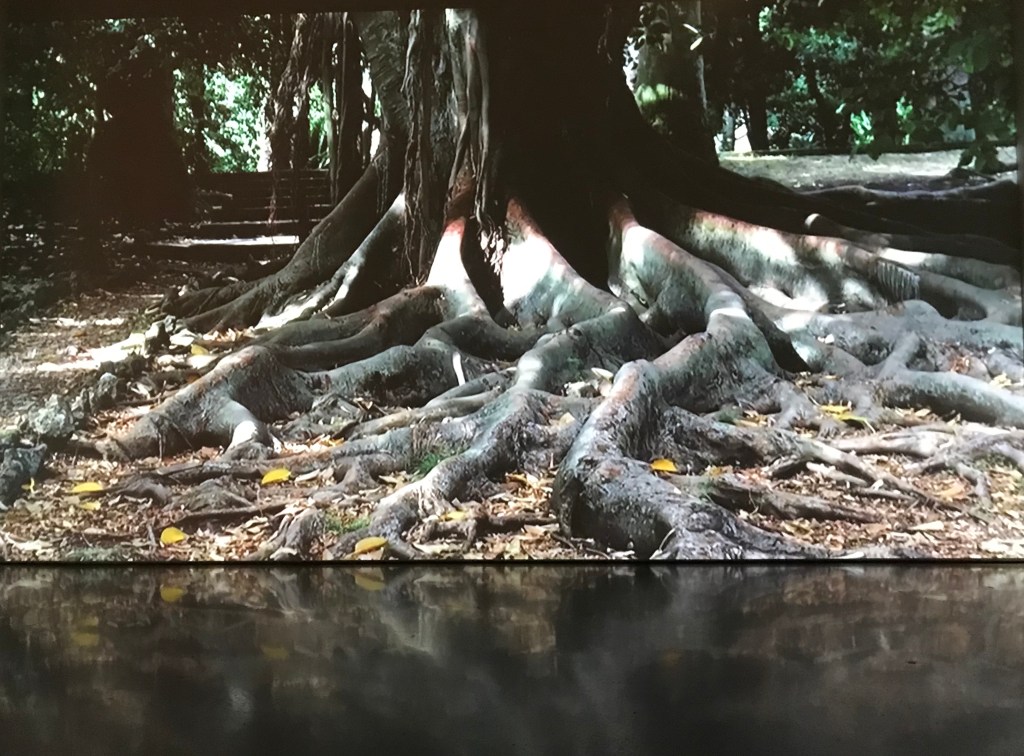
I’ll end my few words today with a note about the image above: it’s a still photo that I took when I saw the film essay, Jardim do Ultramar / The Colonial Garden, by Canadian artist, Shelagh Keeley. While the garden is in Lisbon, Portugal, the image — the roots, the reflection of the roots — is fitting, I think, for today’s blog post. It’s beautiful, that tree. As is this place that many call Canada and that many call home. Certainly, Canada is not without its flaws (and we’re not without our flaws as Canadians), but for each of us, there are reasons to appreciate what it means to live in Canada.
 a few words ... from Montréal